Let's talk about the thing couples never discuss until it's awkward
You orgasm in four minutes. Your partner needs twelve. Or it's the reverse. You finish, they're still building. They climax, you've already plateaued. It's not a dysfunction. It's just... asymmetry. And it quietly poisons the whole experience because one of you is either waiting or rushing.
Here's what I see in my practice over and over: couples assume this means one person is broken. They're not. It means you've been trying to solve a timing problem with willpower, when what you actually need is a tool.
Why orgasm timing becomes a relationship issue (not a bodies issue)
Physiologically, most people with vulvas need more time and consistent stimulation to orgasm than most people with penises. That's not controversial. That's neurology. But couples translate this into a problem. "I'm too slow." "They take forever." "I should be able to come together."
The pressure to sync is real, and it's toxic. It turns pleasure into performance metrics.
What I tell couples is this: synchronization during penetration is a bonus, not a requirement. You can both feel satisfied even if you climax three minutes apart. But here's the catch—you have to actually structure the experience to make that feel good instead of awkward.
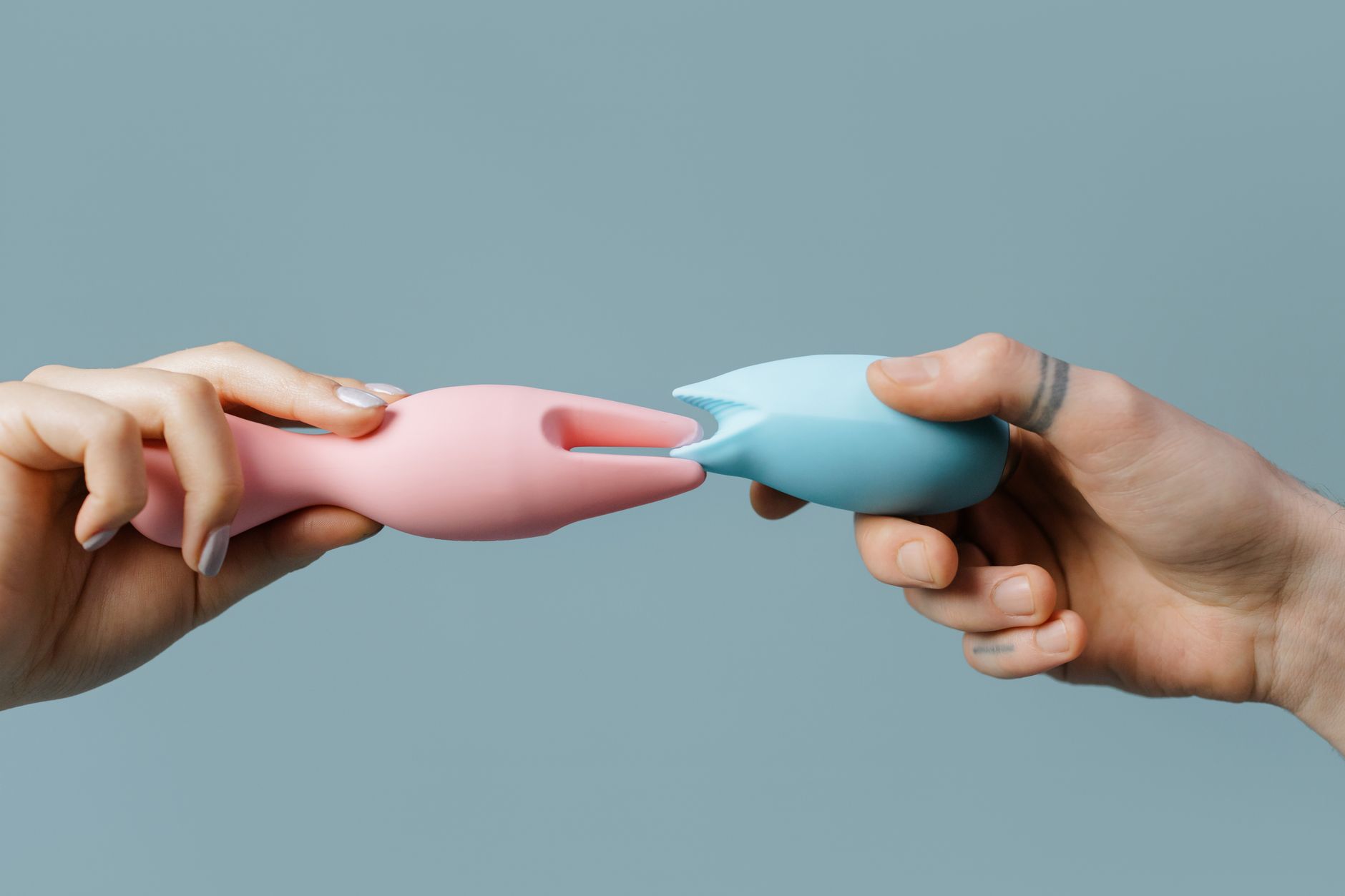
A lemon clitoral vibrator, like the ones from Hello Nancy Lemons Shop, does something unexpected. It doesn't make you orgasm faster or slower. It gives you permission to orgasm on your own timeline while still being emotionally connected to your partner.
The actual mechanics of why this works
Most partnered sex relies on one person stimulating another. When timing is mismatched, you end up in one of three traps:
Trap 1: The waiter. One person finishes early and lies there, manually stimulating themselves, which feels isolating and kills the mood for the partner who's still building.
Trap 2: The rusher. The slower person feels pressure mounting and starts faking it or forcing it, which teaches your nervous system that sex is a performance, not a sensation. That pattern sticks around for years.
Trap 3: The compromise. You both pull back from what actually feels good to stay synchronized. It works for a minute, then resentment builds quietly under the surface.
A lemon sucker vibrator introduces a fourth option: parallel pleasure. You're both stimulating yourselves—or one partner is using the lemon vibrator while the other is inside, or whatever configuration makes sense for your bodies—and you're staying connected through touch, eye contact, or words. You're in the same experience but on your own timeline.
The neurochemical part: when you remove the pressure to sync, your parasympathetic nervous system settles. Your body doesn't need to be vigilant about timing anymore. That means deeper arousal, more intense orgasms, and the whole thing actually feels less fraught.
How to introduce this without it feeling like a workaround
Honestly, the framing matters more than the tool itself.
Don't say: "I'm too slow, so we need this."
Don't say: "You finish too fast. We need to fix this."
Do say: "I want to try something where we both get to feel what actually feels good, without worrying about timing. Would you be open to that?"
Then, when you're actually in bed, keep it practical. You can say things like:
"I'm going to use this on myself while you're inside me." Clear. Sexy. No apologizing.
"What if we both touched ourselves at the same time?" Playful. Inviting.
"Tell me when you're close, and I'll adjust what I'm doing." Communication. Connection.
The lemon clitoral vibrator—especially models like the Lem from Hello Nancy Lemons Shop—is quiet enough that you can talk during sex, which is half the battle. You're not drowning out conversation. You're building it.
The emotional setup that makes this actually work
Here's what trips couples up: you can introduce the most brilliant tool in the world, but if you haven't done the groundwork, it feels like a band-aid on a relationship wound.
Before you bring a vibrator into partnered sex, you both need to believe three things:
- Your orgasm is not your partner's responsibility.
- Your partner's orgasm is not your responsibility.
- You can both feel satisfied even if you climax at different times or in different ways.
If you or your partner believes "they should be able to make me come" or "real sex means we finish together," that needs to shift first. And it's not your individual failing. It's cultural. We've been sold a version of sex that's almost impossible to live up to.
I tell couples: start with a conversation that has nothing to do with the vibrator. Talk about what you actually need, what takes you longest, what feels best. Most couples have never had this conversation in any real depth. The vibrator becomes the easy part.
Practical positioning and rhythm advice
Once you're actually in bed, a few technical things help:
If you're using a lemon vibrator during penetration, most people find the angle easiest if they're lying back with their partner inside them or on top of them. The vibrator works best against the clitoris, which is more accessible when you're not clenching around another body part.
Start at a low setting. You don't need intensity when you're already aroused. Let your partner feel the vibrations against them—it creates a feedback loop. They get stimulation. You get it. Nobody's waiting.
Rhythm-wise, you don't need to match his thrusts. If you're both going at different speeds, that's actually okay. It creates variation that feels more interesting than lockstep movement.
If your partner's getting close faster than you, they can pull out for a minute while you keep going, then come back in. It breaks the pressure of staying inside while you're still building. It's not weird. It's practical.
The couples who enjoy sex the most aren't the ones with matching biology. They're the ones who stopped pretending they have matching biology and built a structure that works for their actual bodies.
When to use it solo first
Honestly, if you've never used a lemon clitoral vibrator before, try it alone first. Not because you need to "practice," but because your nervous system needs to know what it feels like without the added stress of a partner.
Understand your own timeline in silence. Figure out what intensity works. Know how long it takes and what pattern gets you there. Then you can bring that knowledge into the partnered experience without second-guessing yourself.
This removes shame from the equation. You're not showing up unprepared. You're showing up informed.
What happens after
Here's what changes once you've done this a few times: you stop viewing your partner's body as responsible for your pleasure. That sounds clinical, but it's actually liberating. You're no longer in a transaction. You're in an experience together.
Couples tell me they're more affectionate after sex once they've introduced a vibrator because the pressure is gone. Cuddling feels like connection, not recovery. Talking feels like bonding, not coaching.
And sex becomes something you both actually want, instead of something that stresses you both out.
FAQs: Orgasm timing with a partner and lemon vibrators
Will using a vibrator with my partner make them feel replaced?
Not if you frame it as addition, not substitution. The narrative matters enormously. If you talk about it like "you can't make me come, so I need this," yeah, your partner feels replaced. If you talk about it like "I want to feel good AND be close to you," they understand it's the opposite of rejection. Most partners feel relieved. Suddenly they're not managing your orgasm on top of managing their own.
What if my partner thinks a vibrator is "cheating" or "unnatural"?
That's often rooted in the myth that sex should be all one thing. If they're worried it means you don't need them, that's worth a real conversation outside the bedroom. Use it as a prompt to ask: what does our sex mean to you? What makes it feel good? Often you'll find the real issue isn't the vibrator—it's some other insecurity about closeness or desirability. Once you talk about that, the vibrator becomes irrelevant to the actual concern.
How do I know if we're using it wrong?
You're using it "wrong" if someone feels pressured or if it's replacing conversation instead of enhancing it. Otherwise, there's no wrong. If a position feels uncomfortable, adjust. If the setting's too intense, dial it down. If the vibe isn't working for the moment, put it away. Sex is a negotiation, not a script.
Does it change how orgasms feel if I'm using a vibrator and my partner is inside me?
Yes, often in a really good way. The sensation is different—more layered. You're getting internal stimulation, clitoral stimulation, and the psychological component of your partner being involved. Some people say it's more intense. Others say it feels differently kind of good. It's worth exploring without judgment.
What if one of us gets off way faster than expected?
Then you laugh, slow down, switch positions, take a break, or just keep going depending on what feels right. Orgasms aren't scheduled. Sometimes you're right there. Sometimes you thought you were close and you're actually nowhere. That's normal. A vibrator doesn't change that—it just makes it easier to handle without resentment.
Can I use a lemon vibrator with any toy or method my partner prefers?
Yes. A lemon clitoral vibrator plays well with others. It works during penetration with a penis, another vibrator, a dildo, fingers, whatever. It doesn't require anything else—you can use it solo or as part of a bigger configuration. The only real rule is everyone involved consented to what's happening.
The takeaway
Orgasm timing mismatch is one of those issues that couples don't talk about because it feels like failure. It's not. It's just bodies being bodies. And once you stop treating it as a problem to hide and start treating it as a design challenge—"how do we structure this so we both feel satisfied"—everything shifts.
A lemon sucker vibrator from Hello Nancy Lemons Shop is one solution that happens to be quiet, reliable, and genuinely pleasurable. But the real magic isn't the tool. It's the permission. Permission to orgasm on your own timeline. Permission to feel good without managing someone else's experience. Permission to build a version of sex that actually fits your actual bodies.
That permission changes everything.
Ready to explore this with your partner?
If you have questions about how to bring this conversation into your relationship, or you want guidance on which tool might work best for your specific situation, I'm here. Get in touch—I respond to every message.